If you have ever wondered why a thirty second toilet trip somehow turns into forty five minutes of staring at the ceiling afterwards, the answer usually comes down to one simple thing, light. More specifically, it comes down to bright white light hitting your eyes at precisely the worst possible moment in your sleep cycle.
Melatonin Does Not Like Being Interrupted
Melatonin is the hormone responsible for regulating your sleep and wake cycle, and it is extremely sensitive to light, particularly light in the blue and white part of the spectrum, which happens to be what most household light bulbs and bathroom fittings produce. Exposure to bright light in the middle of the night can suppress melatonin production for an extended period, and some research suggests the effect can linger well beyond the moment the light is switched back off.
The practical result of this is that your body starts to think it is time to be awake. Your pupils contract, your brain shifts out of sleep mode, and even once you are back under the covers, it can take considerably longer than the light exposure itself lasted for your body to settle back into proper sleep.
It Is Not Just About Brightness, Colour Matters Too
Not all light affects melatonin equally. Light at the red and amber end of the spectrum has a much smaller suppressive effect on melatonin production than blue white light does, which is why so many sleep researchers specifically recommend red or amber toned lighting for any activity that happens during the night. Hospitals, sleep clinics and even long haul aircraft crews commonly use red lighting in nighttime environments for exactly this reason, allowing people to see and function without triggering a full wake up response.
Why Darkness Alone Is Not the Answer
It might seem like the obvious solution is simply to avoid turning on any light at all and navigate in the dark instead. In practice, for most people this just trades one problem for another. Moving around a bathroom in complete darkness increases the risk of bumping into furniture, missing the toilet entirely, or in more serious cases, tripping or falling, particularly for older adults or anyone getting up feeling groggy and disoriented. Total darkness is not a genuine safety upgrade, it is simply a different kind of risk.
The Real Fix Is the Right Light, Not No Light
The better solution is switching to a soft, automatic, warm coloured light that turns on only when and where it is actually needed, and switches itself off the moment you leave. This removes the need to fumble for a switch in the dark, and it means you are never exposed to a sudden blast of bright white light that your brain interprets as morning.
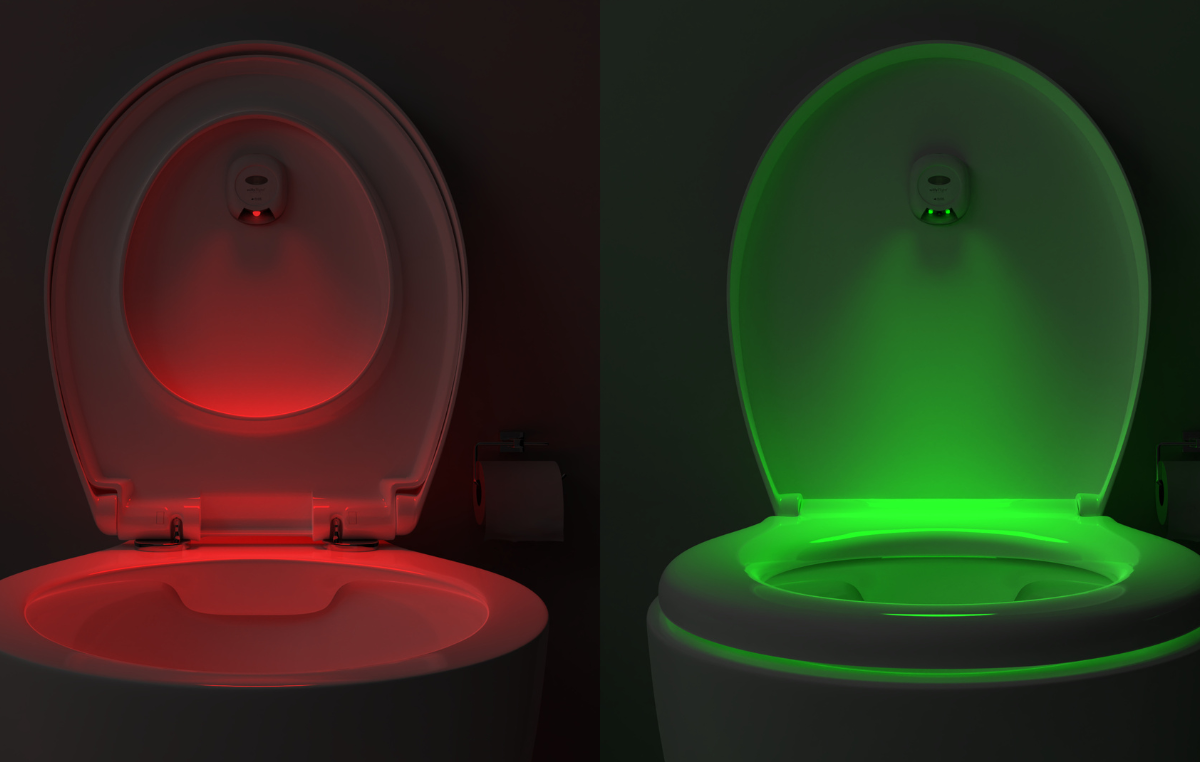
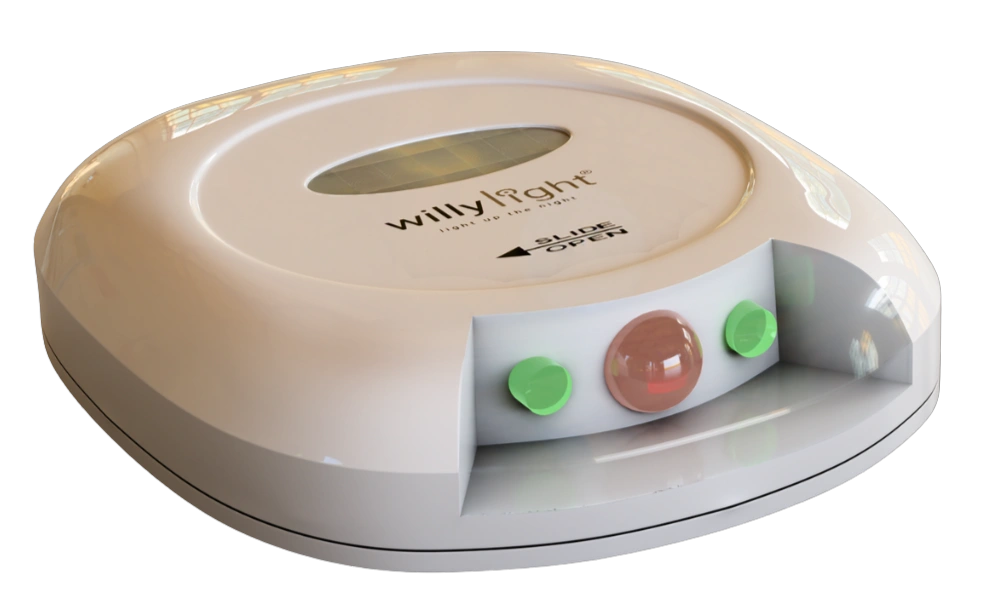
This is the exact idea behind the WillyLight. It attaches to the underside of the toilet lid and uses electronic motion sensors that detect your presence as you enter, glowing with a gentle red or green light depending on whether the seat is up or down. There is no switch to search for, no bright overhead beam, and no need to fully wake yourself up simply to see where you are going.
What This Looks Like in Practice
Consider the typical nighttime routine without any lighting adjustment. You wake up, feel your way to the bathroom door, flick the switch, and are met with a wall of white light that instantly wakes you up properly. You use the bathroom, flick the switch off, and stumble back to bed with spots still floating in your vision, wide awake and unable to settle for the best part of an hour.
Now compare that with a setup using automatic, low glow lighting. You get up, walk toward the bathroom, and a soft glow appears automatically as you approach, just enough to see clearly without anything close to the intensity of a normal light. You use the bathroom, the light switches off automatically as you leave, and you climb back into bed still in a drowsy, half asleep state, ready to drop straight back off.
The difference between those two scenarios, repeated night after night for months or years, adds up to a genuinely significant amount of lost or recovered sleep. It is a small change to make, but for many households it has turned out to be one of the most effective and lowest effort improvements they have ever made to their nightly routine.
Why This Matters Even More for Multiple Trips a Night
If you are only getting up once a night, the melatonin disruption caused by a bright light is unpleasant but limited to a single incident. For the significant number of people getting up two, three or more times a night, the effect compounds considerably. Each fresh dose of bright light resets the melatonin suppression clock, meaning someone getting up three times with a standard bathroom light may spend a meaningful portion of the entire night in a partially disrupted, light suppressed state, rather than moving cleanly through the natural sleep cycle stages the body relies on for proper rest.
How Long Does the Melatonin Disruption Actually Last
Research in this area varies depending on the intensity and duration of light exposure, but general findings suggest that even a brief exposure to bright light can suppress melatonin for a period considerably longer than the exposure itself. This helps explain the common experience of feeling wide awake for thirty to forty five minutes after what felt like a thirty second bathroom visit. The brain does not simply switch back into sleep mode the instant the light goes off, it needs time to reverse the hormonal signal that the light exposure triggered in the first place.
A Simple Household Experiment Worth Trying
If you are sceptical about how much difference lighting alone can make, it is worth running a simple two week experiment. For the first week, continue using your normal bathroom light for nighttime visits as usual. For the second week, switch to a soft, automatic, low glow alternative such as the WillyLight. Many people report a noticeable difference in how quickly they fall back asleep within just a few nights of switching, and it costs very little to find out whether the same holds true in your own household. Backed by a 30 day money back guarantee and priced well under fifty dollars with free shipping, it is a low risk way to test whether this particular change makes the difference for you.